Dali history for curious travelers: from Nanzhao to Bai daily life
A more substantial guide to reading Dali through geography, Nanzhao, the Dali Kingdom, Buddhist kingship, Ming urban layers, Bai culture, Xizhou courtyards, and trade routes.
Start with historical geography, not the souvenir street
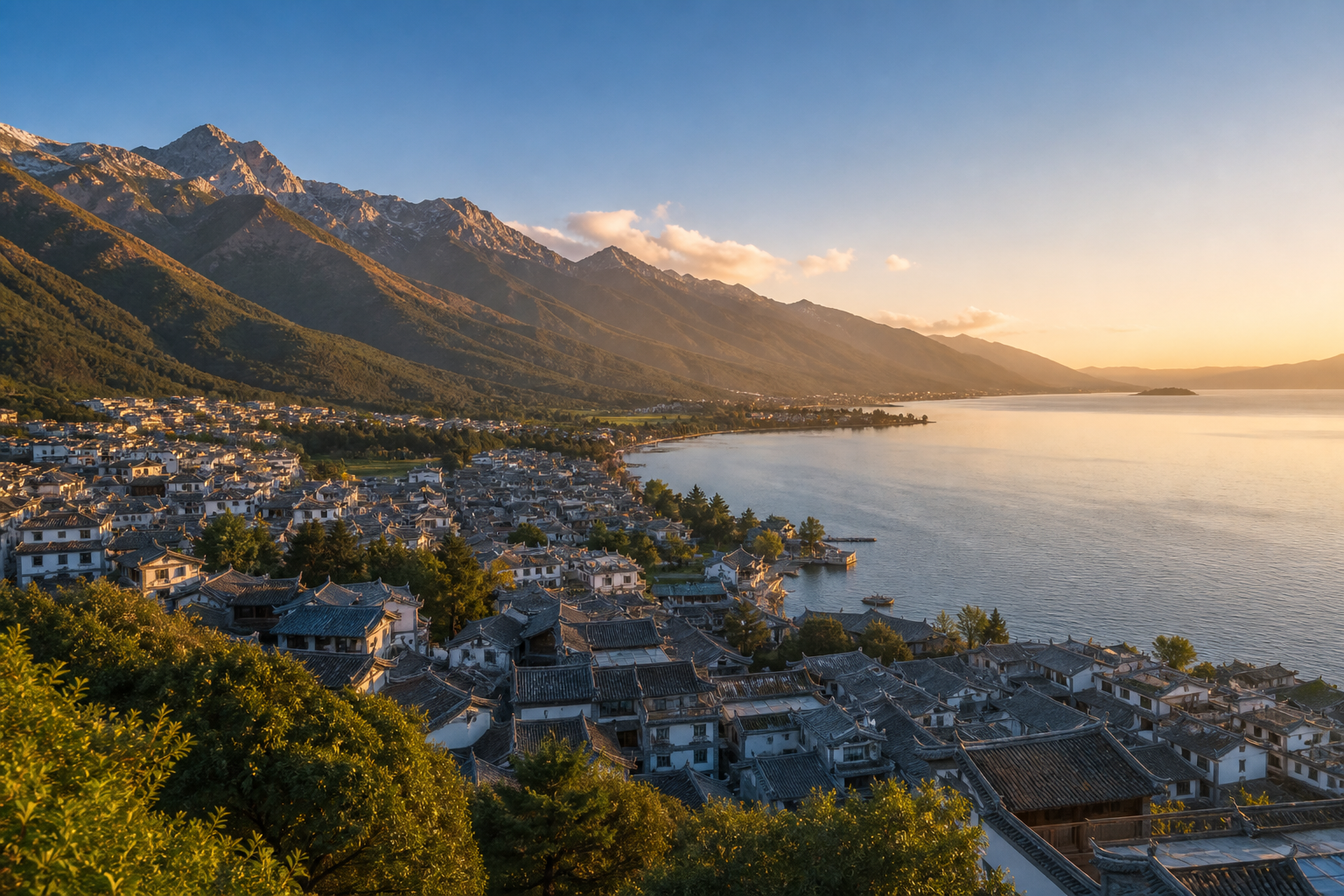
Dali makes more sense if you begin with geography. Cangshan forms the western wall and water source, Erhai opens the eastern plane, and the basin between them became a political, agricultural, religious, and trade space. This mountain-lake frame is why Dali could become more than a pretty town.
For history lovers, Old Town is only one visible layer. The deeper story includes Nanzhao power, the Dali Kingdom, Buddhist kingship, Ming rebuilding, Bai local life, merchant villages, and routes connecting inland China with Tibet, Myanmar, South Asia, and Southeast Asia.
A timeline to keep in your head
A useful Dali timeline runs like this: early habitation around Erhai; Han-era attempts to organize Yunnan as frontier administration; Tang-period consolidation around the six zhao; Nanzhao rising in the eighth century; Nanzhao's collapse in 902; several short regimes; Duan Siping founding the Dali Kingdom in 937; Mongol conquest in 1253; Yunnan becoming a Yuan province in 1276; Ming rebuilding of the current old-town framework around 1382.
This timeline matters because today's Old Town is not simply the preserved capital of Nanzhao or the Dali Kingdom. It is a layered place: kingdom memory, Buddhist traces, later imperial urban form, Bai local society, merchant architecture, and modern tourism all sitting on top of one another.
Nanzhao was not a local legend
Nanzhao is often used as a romantic travel label, but historically it was a serious political force in the Tang-period southwest. It emerged from the consolidation of local powers around Erhai, navigated Tang and Tibetan pressure, and later projected influence toward Myanmar and northern Vietnam.
That changes how you see Dali. It was not interesting because it was remote from history. It was interesting because it stood at a frontier crossroads where empire, highlands, trade, religion, and local power had to negotiate.
The Dali Kingdom and Buddhist kingship
After Nanzhao, the Dali Kingdom was founded in 937 and lasted until the Mongol conquest in 1253. It was not a normal county town and not an isolated mountain myth. It was a regional kingdom with court politics, aristocratic families, temple institutions, and routes linking several worlds.
Recent scholarship emphasizes Buddhist kingship in the Dali Kingdom. Buddhism was not only private belief; it helped express royal legitimacy, sacred authority, and governance. When you see pagodas, temple traces, Buddhist images, or religious place names in Dali, read them as political memory as well as devotion.
Why Buddhism matters so much here
Much of the surviving Dali Kingdom material that scholars discuss is Buddhist: images, texts, ritual memory, and temple culture. Buddhism entered and developed through multiple channels, connected to inland China, Tibet, India, Southeast Asia, and local society.
The Three Pagodas are the clearest visitor-facing entry point. They are not just a postcard landmark. Their placement between mountain, city, temple, and lake helps you understand how sacred architecture made authority visible in the basin.
Duan and Gao: more than one royal surname
Many travelers associate the Dali Kingdom only with the Duan family, sometimes through fiction. The historical structure was more complicated. The Gao family held significant power in the court, and Gao Shengtai briefly founded a short-lived regime in 1094 before the Duan restoration.
This matters because Dali Kingdom history was not a simple portrait of one king in one capital. It was a system of royal house, ministers, temples, local elites, and trade resources.
Mongol conquest, Yuan province, Ming city
The Mongol conquest in 1253 ended the kingdom period. In 1276 Yunnan became a Yuan province, and the political center later shifted toward Kunming. Dali lost its role as kingdom capital but retained cultural, religious, and trade memory.
The current Dali Ancient City is commonly linked to Ming rebuilding around 1382. That means Old Town is historical, but not a direct unbroken snapshot of Nanzhao or the Dali Kingdom. Read its gates, walls, axes, courtyards, and commercial layers as different historical strata.
Bai culture is living culture, not a museum label
Bai culture is essential to understanding Dali, but do not flatten today's ethnic identity into a simple claim of unchanged ancient survival. Ancient polities, languages, social groups, and modern ethnic identity relate in complex ways.
A better approach is to read Bai culture as living local society: markets, festivals, tie-dye, screen walls, courtyards, food, ritual, family houses, and everyday village life. Dali is not only made by royal ruins; it is made by people still living there.
Xizhou, courtyards, and merchant society
Xizhou matters because it shows another kind of history: households, merchants, Bai courtyard architecture, field roads, markets, and modern local life. Look at screen walls, gate towers, courtyard proportions, woodwork, painted details, and how public and family space meet.
Placed beside Three Pagodas, Xizhou helps balance the story. One site gives you kingdom and Buddhist memory; the other gives you domestic architecture and social life.
A better history-lover's route
Do not compress Dali history into half a day. Day 1 can focus on Old Town gates, street axes, side lanes, and urban layers. Day 2 can go to Three Pagodas and the mountain-lake religious frame. If you have more time, add Taihe City ruins, the Nanzhao Dehua Stele, or Shibaoshan Grottoes as deeper extensions.
Day 3 can go to Xizhou and Zhoucheng for Bai courtyards, tie-dye, markets, fields, and village life. This separates Ming urban form, kingdom-Buddhist memory, and local society instead of turning everything into one vague 'ancient town' feeling.
Three reminders for reading Dali
First, do not put all 'ancient' things in one basket. Nanzhao, the Dali Kingdom, Yuan-Ming administration, Qing and Republican houses, and modern tourism are different layers. Second, do not reduce history to dynasty names. Geography, roads, religion, families, trade, and daily life are just as important.
Third, the strongest historical feeling comes from being able to distinguish layers: kingdom memory, Buddhist authority, Ming urban frame, Bai daily life, and modern tourism packaging. When you can do that, Dali becomes not just beautiful but intellectually legible.
Sources and further reading
- Britannica: Dali historical region
- Britannica: Nanzhao
- Britannica: Yunnan history
- Cambridge Core: Buddhist kingship and governance in the Dali Kingdom
- Megan Bryson: Southwestern Chan and the Dali Kingdom
- Visit Yunnan: Old Town of Dali
- UNESCO World Heritage Tentative List: Dali Cangshan Mountain and Erhai Lake Scenic Spot
- UNESCO: Dali-Cangshan UNESCO Global Geopark